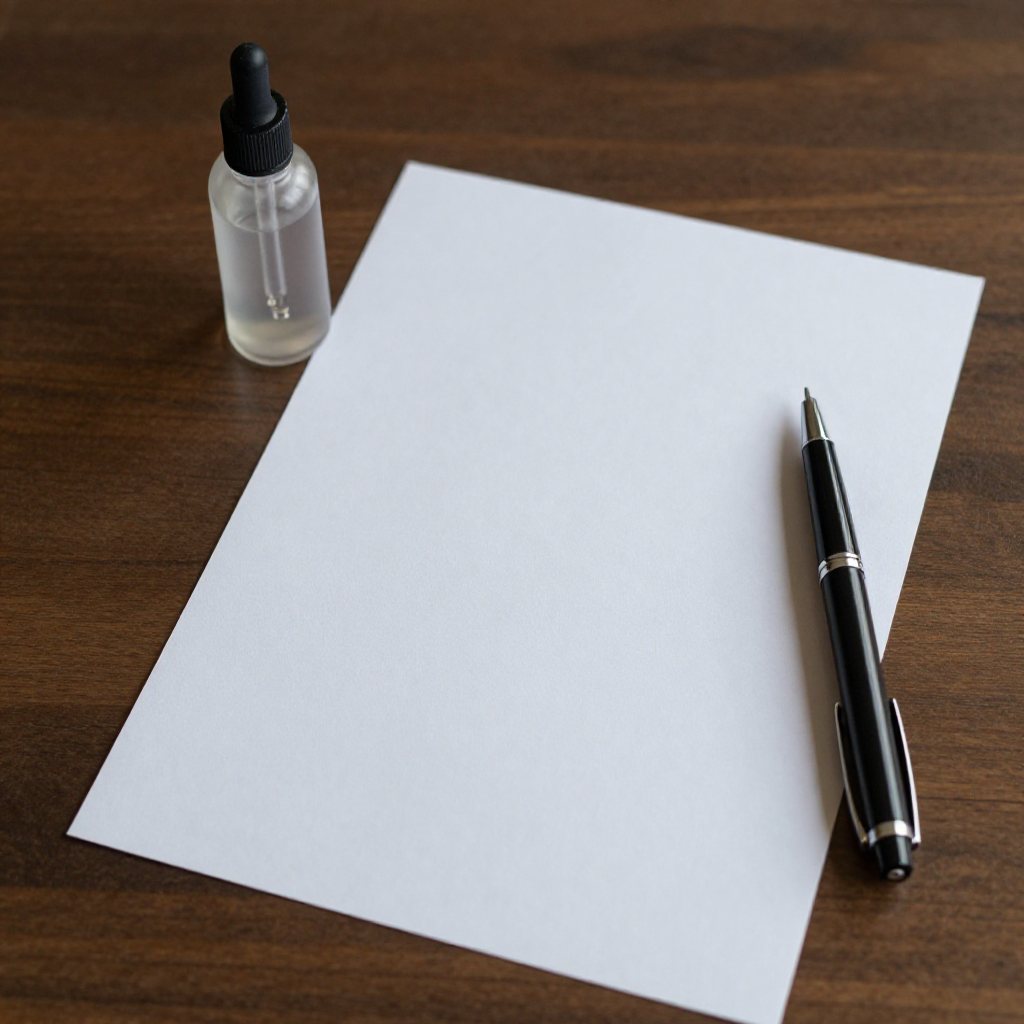
She came in with a single sheet of paper她帶著一張紙來
Six ingredients, two ringed in red: hydroquinone, kojic acid.紙上六個成分,紅筆圈了兩個:氫醌、曲酸。
Ms. Lam came with a piece of paper.
Six ingredients were listed on it, two of them circled in red: HYDROQUINONE, KOJIC ACID.
"These two are what I want." She pushed the paper across. "Don't tell me it can't be done."
May picked the paper up, looked it over, and handed it to Qiang.
Act One: She wanted the fastest
Ms. Lam worked the African market — two lines, Nigeria and Ghana.
"My customers over there," she said, "want 'white as soon as you use it'. You can talk to them about gentleness, about low irritation — they don't listen. They want to see a difference."
"So you want hydroquinone."
"Yes. And kojic acid — a bigger dose."
Qiang turned the paper over, looked at the back, and set it down on the table again.
"Ms. Lam, let me ask you a question first," he said. "Which countries is this batch going to?"
"Nigeria mainly; some Ghana, a little Côte d'Ivoire."
"Then we can't do it."
Act Two: Not a refusal, a customs problem
"Why not?" Her voice tightened. "They sell it all over Africa, and you tell me it can't be done?"
"Selling it, and being allowed to sell it, are two different things," Qiang said. "Nigeria bans hydroquinone. Not a limit — a ban. Your goods arrive in Lagos, customs runs a spot check, and one bottle is enough to hold the whole container."
"What about kojic acid? Is that banned too?"
"Kojic acid isn't banned, but it is restricted," Qiang said. "And —" he paused, "the fact that you have written these two together tells me you haven't worked out what they are."
Ms. Lam said nothing.
"Hydroquinone is a prescription-drug-grade ingredient," Qiang said, "while kojic acid comes from Aspergillus fermentation. Two completely different things, with different regulatory limits. Class them as one, and your paperwork at customs declaration will be wrong."
May added: "And any buyer on the client's side can tell from your ingredient list whether you know this trade."
Act Three: Then what can I do
Ms. Lam leaned back in her chair and was silent for a moment.
"Qiang, let me be straight with you. If this batch doesn't carry those two, I can't sell it."
"You can't sell it, or you think you can't sell it?"
"…Is there a difference?"
"There is." Qiang turned the tablet around. "Tell me — after your customer uses it, what does she say to you?"
"That her face looks brighter, that the spots have faded."
"Then what she wants is 'the spots have faded', not 'hydroquinone'," Qiang said. "Hydroquinone is what you told her; the spots fading is what she saw for herself."
"So?"
"So we change route. We deliver the fading of the spots without touching hydroquinone."
Act Four: Four routes stacked
Next he broke the proposal into four lines.
"The first line, Glabridin," Qiang said. "Inhibits tyrosinase. The use level is very low — 0.02 to 0.05 is enough — and irritation is low. The drawback is poor solubility and easy crystallisation; we solve that by pre-dissolving."
"The second line, Alpha-Arbutin." He held up two fingers. "It is a glycoside derivative of hydroquinone, released slowly after it enters the skin. Less efficient than hydroquinone, but far safer."
"Wait," Ms. Lam cut in. "Isn't arbutin also a hydroquinone type? So isn't it the same thing?"
"It is not the same," Qiang said. "Hydroquinone acts directly; arbutin has to be cleaved by enzymes first before it becomes hydroquinone, and the concentration is extremely low and the process slow. Legally they are two completely different substances — one is banned, the other may be used up to a certain concentration."
"Which concentration?"

"There is a trap here," Qiang said. "Alpha-Arbutin has a ceiling in the EU: 2% for facial products, 0.5% for body products. Plenty of formula sheets write 2.5%, 3%, on the grounds that it sells in other markets. But if any part of this batch is going into the EU, that concentration won't get through."
Ms. Lam frowned. "This batch isn't going into the EU."
"And later?" Qiang asked. "You work the Africa line, and African countries have been moving toward EU standards these past two years. Not entering the EU today doesn't mean not entering next year."
Ms. Lam did not answer.
"So my advice is: build it at 2%," Qiang said. "Not for the EU — so that three years from now you don't have to file all over again."
"The third line, niacinamide," he went on. "3 to 5%. It doesn't whiten directly; it makes melanin that has already formed less likely to reach the epidermis. The 'brighter face' you want — it contributes a great deal to that."
"The fourth line, a vitamin C derivative," Qiang said. "But not native vitamin C — pure vitamin C goes yellow in a warehouse of yours in three months. Use Ascorbyl Glucoside or Magnesium Ascorbyl Phosphate; far more heat-resistant."
"What happens if it goes yellow?"
"It's not just ugly," Qiang said. "The oxidised products become more irritating. You're selling into a hot, humid place — you can't leave this one out."
Act Five: What was left
At the end of the meeting, Ms. Lam folded the ingredient list and put it in her bag.
"Qiang, when I go back I have to explain to my partner why we are not using hydroquinone."
"Then just say one thing to him."
"What?"
"Tell him: hydroquinone is banned in Nigeria. Not a limit — a ban. One container held once, and this line of ours won't recover for three years."
Ms. Lam smiled a little. "You always do this — start with the worst."
"Because the worst is the one you have to carry yourself," Qiang said.
After she left, May closed the tablet and asked:
"Boss, actually, if she insists, we could do it — just not write it on the label."
"That would be doing her harm." Qiang dropped the photocopy of the ingredient list into the shredder. "In contract manufacturing, the most valuable thing isn't the formula — it's knowing which line must not be crossed."

May wrote that sentence down.
FAQ
Q: Why can't hydroquinone be used?
A: The EU, many ASEAN countries and many African countries all ban hydroquinone in cosmetics. A few markets allow it within limits, but for a contract manufacturer, goods containing hydroquinone can only reach a handful of markets, and the risk of customs seizure is high.
Q: Does Alpha-Arbutin count as hydroquinone?
A: It is a glycoside derivative of hydroquinone, but legally it is a completely different substance. Alpha-Arbutin has concentration ceilings in the EU (≤2% facial, ≤0.5% body), and within those limits it is legal to use.
Q: Without hydroquinone, will the results be much worse?
A: Judged by a single ingredient, it is indeed somewhat weaker. But whitening is a composite route — inhibit tyrosinase, inhibit melanin transfer, antioxidant reduction — and with all three stacked, a compliant formula can still deliver perceptible improvement.
Q: Where can I see the complete formula framework?
A: There is a separate technical note, "Whitening Serum: The Hydroquinone-Free Route and Three Ingredients That Get Confused", which covers the concentration windows of the four pathways, the stability risks and the export regulations.
林小姐是帶著一張紙來的。
紙上列著六個成分,用紅筆圈了兩個:HYDROQUINONE、KOJIC ACID。
「這兩樣我要。」她把紙推過來,「別跟我說不行。」
May 把紙拿起來看了看,遞給強哥。
第一幕:她要的是最快的
林小姐做非洲市場,尼日利亞和加納兩條線。
「我那邊的客人,」她說,「要的是『用了就白』。你給我講什麼溫和、什麼低刺激,他們不聽。他們要看到差別。」
「所以你要氫醌。」
「對。還有曲酸,加多一點。」
強哥把那張紙翻過來,看了看背面,又放回桌上。
「林小姐,我先問你一個問題。」他說,「你這批貨,賣到哪幾個國家?」
「尼日利亞為主,加納、科特迪瓦也走一點。」
「那就做不了。」
第二幕:不是不願意,是海關過不去
「為什麼?」林小姐的聲音緊了,「非洲那邊到處都在賣,你跟我說做不了?」
「在賣,和能賣,是兩件事。」強哥說,「尼日利亞對氫醌是禁的。不是限量,是禁。你貨到拉各斯,海關抽檢,一瓶就夠讓整櫃扣下來。」
「那曲酸呢?曲酸也禁?」
「曲酸不禁,但有限制。」強哥說,「而且——」他頓了一下,「你把這兩個寫在一起,說明你還沒搞清楚它們是什麼。」
林小姐沒說話。
「氫醌是處方藥級別的成分,」強哥說,「曲酸是麴菌發酵來的。兩個完全不同的東西,法規限值也不一樣。你把他們歸成一類,報關的時候文件就寫不對。」
May 補了一句:「而且客戶那邊的採購,一看你的成分表就知道你懂不懂行。」
第三幕:那我能做什麼
林小姐靠在椅背上,沉默了一會兒。
「強哥,我實話說。我這批貨要是不帶這兩個,我賣不動。」
「賣不動,還是你覺得賣不動?」
「……有區別嗎?」
「有。」強哥把平板轉過來,「你告訴我,你的客人用了之後,跟她說什麼?」
「說臉亮了,斑淡了。」
「那她要的是『斑淡了』,不是『氫醌』。」強哥說,「氫醌是你告訴她的,斑淡了是她自己看到的。」
「所以呢?」
「所以我們換一條路,把斑淡這件事做出來,但不碰氫醌。」
第四幕:四條路疊起來
接下來他把方案拆成四條線。
「第一條,Glabridin。」強哥說,「光甘草定,抑制酪氨酸酶。用量很低,0.02 到 0.05 就夠,刺激性也低。缺點是溶解性差,容易結晶——這個我們用預溶解決。」
「第二條,α-熊果苷。」他伸出兩根手指,「它是氫醌的糖苷衍生物,進皮膚之後慢慢釋放。效率比不上氫醌,但安全性高得多。」
「等等,」林小姐插話,「熊果苷不是也是氫醌類的嗎?那還不是一樣?」
「不一樣。」強哥說,「氫醌是直接的,熊果苷是要先被酶切開才變成氫醌,而且濃度極低、過程緩慢。法規上它們是兩個完全不同的東西——一個禁,一個可以用到某個濃度。」
「哪個濃度?」
「這裡有個坑。」強哥說,「α-熊果苷在歐盟有上限:面部產品 2%,身體產品 0.5%。很多配方表寫 2.5%、3%,理由是別的市場能賣。但只要你這批貨有任何一部分要進歐盟,這個濃度就過不去。」
林小姐皺眉:「我這批不進歐盟。」
「那你以後呢?」強哥問,「你做非洲線,非洲各國這兩年也在跟歐盟的標準靠。今天不進歐盟,不等於明年不進。」
林小姐沒接話。
「所以我的建議是:按 2% 做。」強哥說,「不是為了歐盟,是為了你三年後不用重新備案。」
「第三條,煙酰胺。」他繼續,「3 到 5%。它不直接美白,是讓已經生成的黑色素不容易跑到表皮。你要的『臉亮了』,它貢獻很大。」
「第四條,維生素 C 衍生物。」強哥說,「但不用原型維 C——純維 C 在你們那邊的倉庫裡,三個月就黃了。用抗壞血酸葡糖苷或者磷酸酯鎂,耐熱得多。」
「黃了會怎樣?」
「不只是難看。」強哥說,「氧化後的產物刺激性會上升。你是賣到高溫高濕的地方,這一項不能省。」
第五幕:留下來的判斷
會開到最後,林小姐把那份成分清單摺起來,放進包裡。
「強哥,我回去要跟合夥人解釋,為什麼我們不用氫醌。」
「你就跟他說一句話。」
「什麼?」
「跟他說:氫醌在尼日利亞是禁的。不是限量,是禁。一櫃貨被扣一次,我們這條線三年翻不了身。」
林小姐笑了一下:「你每次都這樣,先講最壞的。」
「因為最壞的那個,是你自己要承擔的。」強哥說。
她走了之後,May 把平板合上,問了一句:
「老闆,其實如果她堅持,我們是可以做的——只是不寫在標籤上。」
「那是害她。」強哥把那張成分清單的複印件丟進碎紙機,「我們做代工,最值錢的不是配方,是知道哪條線不能過。」
May 把這句話記了下來。
常見問題
Q:為什麼不能用氫醌?
A:歐盟、東盟多國、非洲多國都禁止在化妝品中使用氫醌。少數市場有限量允許,但對代工廠來說,含氫醌的貨走不出幾個市場,且海關扣貨風險高。
Q:Alpha-熊果苷算氫醌嗎?
A:它是氫醌的糖苷衍生物,但法規上是完全不同的東西。α-熊果苷在歐盟有濃度上限(面部 ≤2%、身體 ≤0.5%),在限值內是合法可用的。
Q:不用氫醌,效果會不會差很多?
A:單一成分看確實弱一些。但美白是複合路徑——抑制酪氨酸酶、抑制黑色素轉運、抗氧化還原,三條路疊起來,合規配方也能做出可感知的改善。
Q:完整配方框架在哪裡看?
A:另有一篇技術筆記《美白精華:無氫醌路線與三個容易搞混的原料》,講了四條路徑的濃度窗口、穩定性風險與出海法規。
Questions about this process?對這道工序有疑問?
Ask us and we will answer in writing, with the batch records to back it up.問我們,我們會以書面回覆,並附上批記錄。