The same formula in a different dosage form is not the same product同樣的配方,換個劑型就不一樣了
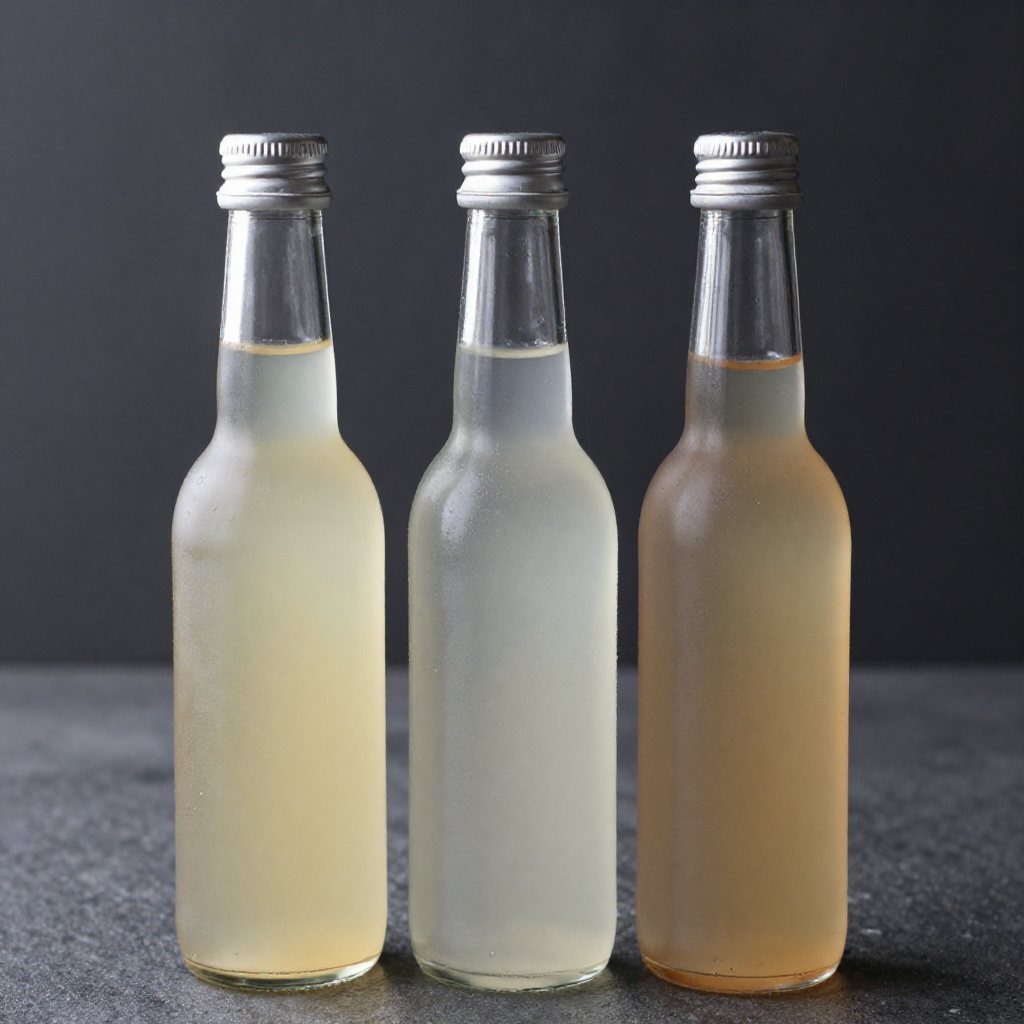
An emulsion with alpha-arbutin discoloured after 28 days at 40°C — while more than 90% of the active was still there. The product was fine; the buyer returned it anyway. In tropical markets the first killer is not the active. It is the dosage form.一款含 α-熊果苷的乳劑,40°C 放 28 天就變色了 —— 但活性殘留還有 90% 以上。東西是好的,客戶卻退貨了。熱帶市場的第一殺手不是成分,是劑型。
In formulation circles, nine sentences out of ten about whitening are about ingredients: which one inhibits tyrosinase, which one blocks transport, which one is an antioxidant.
Rarely does anyone discuss the dosage form.
But for anyone serving a tropical market, the dosage form is a likelier cause of returns than the ingredients.
1. Discolouration: the most common reason for returns, and the least discussed
There is one set of experimental data worth remembering:
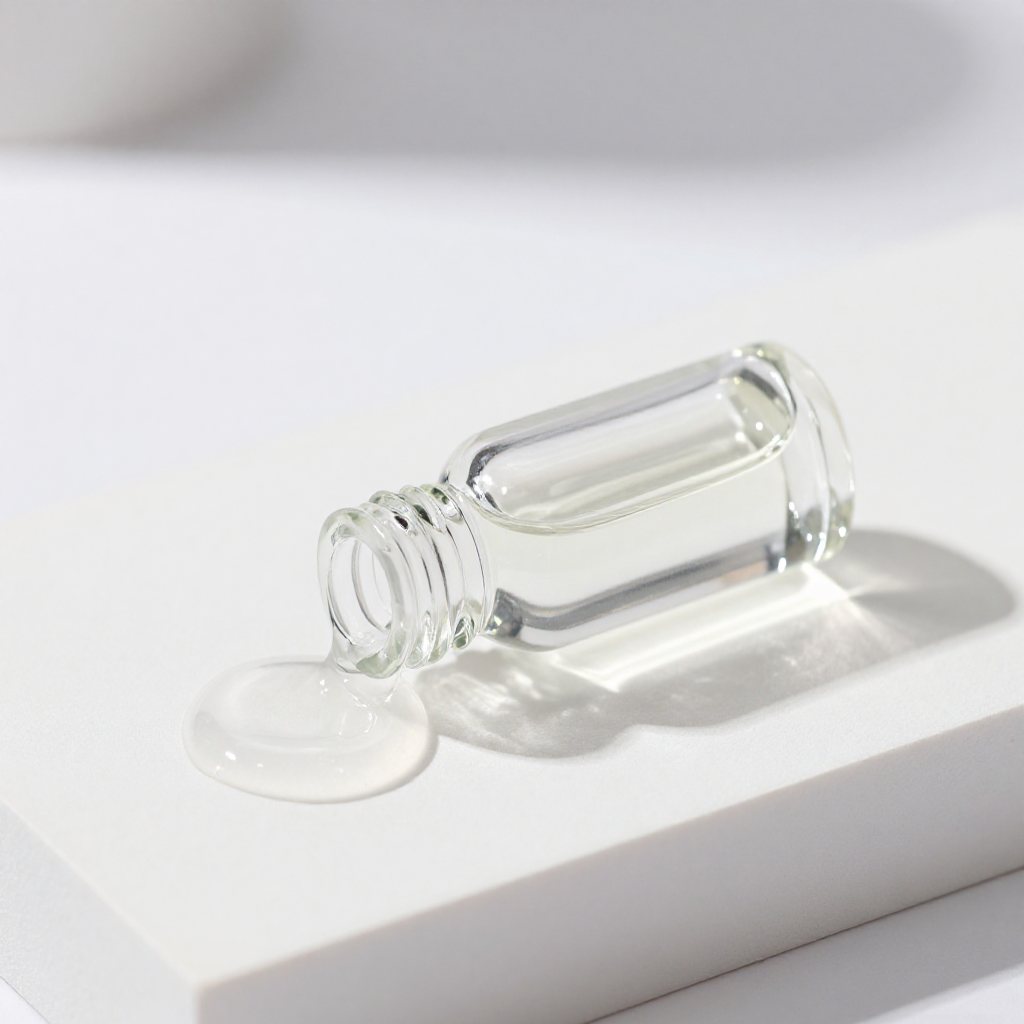
An O/W emulsion containing alpha-arbutin, stored at 40°C for 28 days, showed discolouration visible to the eye. Over the same period, the residual active content remained above 90%.
In other words — the product was still good, but the customer returned it.
Because the buyer does not run an assay. The buyer simply opens the carton and sees that the colour is wrong.
That is the real destructive force of a dosage-form problem: it does not affect efficacy, yet it brings the transaction to an immediate end.
2. Emulsion vs oil-free gel: the oil phase is the oxidation substrate
Why does an emulsion discolour so readily?
Because an emulsion contains an oil phase and an emulsifier. Both can oxidise: oxidised oils and fats generate aldehydes and ketones and deepen the colour, and the emulsifier itself may also degrade.
The actives commonly found in whitening formulas (vitamin C derivatives, arbutin, plant extracts) are precisely the ones most easily oxidised. Placed in the same system as the oil phase, they are effectively accelerated together.
The reasoning behind an oil-free water gel is straightforward: remove the substrate that can oxidise.
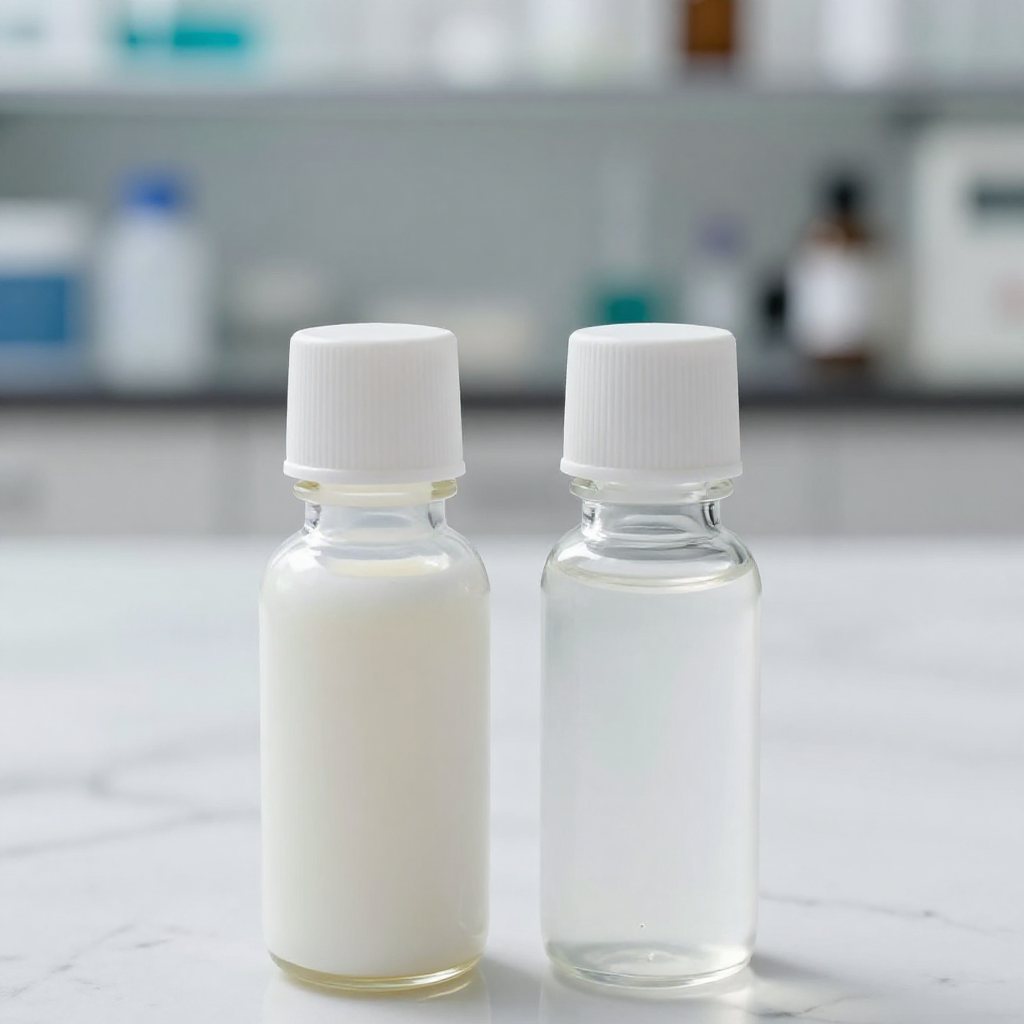
With no oil phase and no emulsifier, a large part of the oxidation source is gone. The remaining risk is concentrated in the actives themselves and the aqueous phase; it is handled with antioxidants, a chelating agent and light-protective packaging, and is far more controllable.
Two further benefits come along with it:
· No tackiness returning in humid conditions. After an emulsion is applied, the oil phase tends to become tacky again above 35°C, leaving a film of floating oil on the face; a water gel stays matte.
· One less comedogenic variable. No emulsifier, no silicone oil, no alcohol — a system that is friendlier to acne-prone skin and to hot, stuffy climates.
3. What happens at 40°C
A tropical warehouse sits at 35–45°C year-round, and a sea freight container can reach 50°C. At such temperatures an oil-free gel is not invincible either. Four risks have to be handled one by one:
· Discolouration: the dominant risk, covered in Section 1. The countermeasures are a chelating agent (EDTA) plus antioxidants plus light-protective or dark packaging, with nitrogen blanketing where necessary.
· Gel collapse / syneresis: high temperature lowers the viscosity of the thickening system. An electrolyte-tolerant thickener (AMPS-type copolymers) must be selected, and a lower viscosity limit must be set in the specification, rather than looking only at the initial viscosity.
· pH drift: at elevated temperature and away from neutral pH, niacinamide hydrolyses into nicotinic acid and causes flushing and stinging. pH must therefore be controlled, the addition temperature controlled (added below 70°C), and a retain sample of the finished product monitored for pH drift.
· Preservation pressure: an oil-free gel has high water activity, so the risk from moulds and yeasts is higher than in an emulsion. A low-irritation system (low fragrance, low alcohol) is precisely the harder one to preserve, and it must pass a microbial challenge test.
⚠️ There is one further, specific risk: free hydroquinone.
Alpha-arbutin is stable in a conventional formula (pH 5.0–5.5) and releases hydroquinone only under strongly hydrolytic conditions. Enzymatic contamination, however, accelerates the process. So beyond controlling pH, preservation must be adequate, and the free hydroquinone content must be tested before shipment — the item most easily questioned by clients on a whitening product.
4. Three market variants: one skeleton, swappable modules
The worst thing in private-label work is the phrase 'every client needs a formula built again from scratch'. The method is to split the formula into a skeleton plus modules:
· Skeleton: aqueous phase, thickening, humectants, preservation, pH. Validated once, this layer is shared by every order.
· Module: the whitening active layer. Added or reduced according to the market and price point the client wants.
One skeleton can support three variants:
· Standard version: all four pathways covered, including alpha-arbutin. Suited to most Southeast Asian and Middle Eastern markets.
· Arbutin-free version: alpha-arbutin is removed and the tranexamic acid and glabridin ratios are raised. Suited to markets with additional registration requirements for arbutin, or to orders for export to the EU.
· Gentle sensitive-skin version: niacinamide and tranexamic acid are both reduced, with soothing ingredients added. Suited to highly sensitive skin and acne-prone skin in African cities.
⚠️ Note, however: modules can only be added or removed within what the skeleton can bear. If, for example, too much active is added, the preservation system is diluted and the skeleton has to be revised in turn. That boundary must be written into the formula file.
5. Regulatory differences across seven markets
Regulatory differences in the whitening category are far greater than in ordinary skincare, and they have been tightening over the past two years. Each market is taken separately below:
· Nigeria (NAFDAC): in November 2025 the first National Policy on Cosmetics Safety and Health (2026–2030) was adopted. All products must be registered through NAPAMS, the declared processing period for imports is 120 working days, and certificates are valid for 5 years. Under the 2019 Bleaching Agents (Prohibition) Regulations, hydroquinone is 'prohibited above 2%' — meaning that below 2% it is still permitted, although NAFDAC issued repeated public warnings in 2025 about products over the limit.
· South Africa: hydroquinone has been banned outright as a skin-lightening agent since 1990. This is entirely different from Nigeria's '≤2% permitted' and cannot be carried over. Labels must also avoid words such as bleaching / lightening and use tone-evening / brightening instead.
· Kenya / East Africa (EAC): governed by KS 2937:2021 and the EAS 377 series. Eleven new EAC harmonised standards were adopted in January 2026. Where one formula serves several East African countries, the version of the preservative and UV filter lists in EAS 377 must be checked first.
· Egypt (EDA): notification through EgyCosm, plus Ministerial Decree No. 114 of 2026; the transitional period for ISO 22716 manufacturing authorisation runs until 2027-04-16. The contract manufacturer's GMP certificate must be confirmed as still valid.
· ASEAN (Thailand, Vietnam, the Philippines, Indonesia, Malaysia, Singapore): hydroquinone is prohibited. Kojic acid is restricted to 1% (revised by Malaysia's NPRA for leave-on face / neck / hand products). Arbutin requires additional data in certain individual countries.
· European Union: hydroquinone is prohibited. Since 2025-11-01, kojic acid may not be placed on the market at concentrations above 1%. The facial upper limit for alpha-arbutin is 2% (SCCS opinion) and 0.5% for body products.
· Middle East (Saudi SFDA, UAE): a full ingredient list, GMP evidence and Arabic labelling are required. Gulf markets scrutinise 'whitening' claims rather strictly, and brightening / even tone claims are safer than whitening.
⚠️ Three points that are easily got wrong:
· Nigeria's '≤2% permitted' is not an African general rule. South Africa and Kenya ban it outright.
· The 1% for kojic acid is an upper limit, not a recommended value. And the EU effective date has already passed.
· The registration requirement for arbutin is 'additional data in certain individual countries', not 'required in every country'.
6. The delivery pack for the client
On a private-label order the client needs more than a formula: it needs a complete set of documents that can be taken to registration. They are best prepared in one go:
· Full ingredient list (INCI) — the basis for registration / notification in each country
· Raw material COA + MSDS — for the client's filing and internal review
· Declaration of no hydroquinone / no mercury / no hormones / no kojic acid — for customs clearance and platform review. A framework version can be issued in advance, and this is the easiest item to sell
· Stability report: 40°C / 75% RH for three months, 45°C for four weeks, three freeze-thaw cycles
· Microbial challenge test (ISO 11930)
· Free hydroquinone test report — mandatory whenever the formula contains arbutin
· ISO 22716 / GMP certificate — registration in Egypt, the Middle East and Africa will always ask for it
FAQ
Q: Is an oil-free gel insufficiently moisturising?
A: Oil-free does not mean moisture-free. Moisturising depends on water-soluble humectants such as glycerin, propylene glycol, butylene glycol and hyaluronic acid, not on oil. What tropical markets ask for is precisely 'moisturised but not tacky', and a water gel suits that better.
Q: Why insist on 'oil-free'?
A: Because the oil phase is the oxidation substrate. In a warehouse at 40°C, one large oxidation source gone means one large block of discolouration risk gone. This is a dosage-form choice, not concept marketing.
Q: Can alpha-arbutin be used at all?
A: It can, but two things must be controlled: pH 5.0–5.5, and testing for free hydroquinone before shipment. The EU facial upper limit is 2%, and it must not be exceeded. If the target market has additional requirements for arbutin, switch to the arbutin-free version.
Q: Do the three variants need three separate sets of stability testing?
A: Yes. Sharing the skeleton saves part of the work, but a different active layer means a different formula, and stability and preservative challenge testing must each be completed separately. This cost cannot be saved.
Q: Can the ratios in this article go straight into production?
A: No. What this article gives is dosage-form reasoning, concentration windows and regulatory key points, not a filing-ready formula. The actual formula must be completed by a formulator in line with the target market's regulations, and must pass stability, microbial challenge and free hydroquinone testing.
配方圈子裡討論美白,十句話有九句在講成分:哪個抑制酪氨酸酶、哪個阻斷轉運、哪個抗氧化。
很少有人講劑型。
但如果你做的是熱帶市場,劑型比成分更容易讓你退貨。
一、變色:最常見的退貨原因,卻最少人講
有一個實驗數據,值得記住:
一款含 α-熊果苷的 O/W 乳劑,在 40°C 存放 28 天,出現了肉眼可見的變色。但同一時間,活性物的殘留量還在 90% 以上。
換句話說——東西還是好的,但客戶退貨了。
因為買家不會做含量檢測。他只會打開箱子,看見顏色不對。
這就是劑型問題的真正殺傷力:它不影響效果,卻直接終止交易。
二、乳劑 vs 無油凝膠:油相是氧化的底物
為什麼乳劑容易變色?
因為乳劑裡有油相,有乳化劑。這兩樣都是可以氧化的東西——油脂氧化會產生醛、酮,顏色變深;乳化劑本身也可能降解。
而美白配方裡常見的活性物(維生素 C 衍生物、熊果苷、植物提取)恰恰都是容易被氧化的。它們和油相放在同一個體系裡,等於一起被加速。
無油水凝膠的思路很直接:把可以氧化的底物拿掉。
沒有油相,沒有乳化劑,就少了一大塊氧化來源。剩下的風險集中在活性物本身與水相,用抗氧化劑、螯合劑和避光包材來處理,可控得多。
另外兩個好處順帶而來:
· 高濕環境不返黏。乳劑塗完之後,油相在 35°C 以上容易「回黏」,臉上有一層浮油感;水凝膠是啞光的。
· 少一個致痘變數。無乳化劑、無矽油、無酒精,對痘肌和悶熱氣候更友好。
三、40°C 下會發生什麼
熱帶倉庫常年 35–45°C,海運貨櫃能到 50°C。這個溫度下,無油凝膠也不是無敵的。四個風險要逐一處理:
· 變色:最主要的風險,見第一節。對策是螯合劑(EDTA)+抗氧化劑+避光或深色包材,必要時充氮置換。
· 凝膠塌陷/滲水:高溫會讓增稠體系降黏。要選耐電解質的增稠劑(AMPS 類共聚物),並在規格裡設黏度下限,而不是只看初始黏度。
· pH 漂移:煙酰胺在偏高溫、pH 偏離中性時會水解成菸鹼酸,引起潮紅刺痛。所以要控 pH、控加入溫度(低於 70°C 加),並對成品留樣監測 pH 漂移。
· 防腐壓力:無油凝膠的水活度高,黴菌和酵母的風險比乳劑更高。低刺激體系(低香精、低酒精)恰恰防腐更難,必須通過微生物挑戰測試。
⚠️ 還有一個特殊風險:游離氫醌。
α-熊果苷在常規配方(pH 5.0–5.5)下是穩定的,只在強水解條件下才會釋放氫醌。但酵素污染會加速這個過程。所以除了控 pH,還要防腐到位,出貨前檢驗游離氫醌含量 —— 這是美白產品最容易被客戶質疑的一項。
四、三個市場變體:同一骨架,換模組
做私標訂單最怕的是「每個客戶都要重新做一個配方」。做法是把配方拆成骨架 + 模組:
· 骨架:水相、增稠、保濕、防腐、pH。這一層驗證一次,所有訂單共用。
· 模組:美白活性層。按客戶要的市場和價位增減。
以同一組骨架,可以出三個變體:
· 標準版:四路徑齊全,含 α-熊果苷。適合東南亞、中東大部分市場。
· 零熊果苷版:拿掉 α-熊果苷,把傳明酸與光甘草定的比例往上調。適合對熊果苷有額外註冊要求的市場,或要出口歐盟的訂單。
· 溫和敏感版:煙酰胺與傳明酸都降下來,加舒緩成分。適合非洲城市的高敏人群、痘肌。
⚠️ 但要注意:模組的增減不能超過骨架的承受範圍。例如活性物加太多,防腐體系會被稀釋,那就得回頭改骨架。這個邊界要寫進配方檔案。
五、七個市場的法規差異
美白品類的法規差異比一般護膚大得多,而且這兩年還在收緊。以下按市場分開講:
· 尼日利亞(NAFDAC):2025 年 11 月通過首個《國家化妝品安全與健康政策(2026–2030)》。所有產品須經 NAPAMS 註冊,進口品公示處理期 120 個工作日,證書有效期 5 年。氫醌在 2019《漂白劑禁用條例》下是「>2% 違禁」——意思是 2% 以下仍可,但 NAFDAC 2025 年多次公開警告超標產品。
· 南非:1990 年起就禁止氫醌作為亮膚劑。這跟尼日利亞的「≤2% 允許」完全不同,不能照搬。標籤上還要避開 bleaching / lightening 這類字眼,改用 tone-evening / brightening。
· 肯尼亞/東非(EAC):依 KS 2937:2021 與 EAS 377 系列。2026 年 1 月新採納 11 項 EAC 統一標準。一份配方做東非多國時,要先核對 EAS 377 的防腐劑與 UV 清單版本。
· 埃及(EDA):EgyCosm 通報,加上 2026 年第 114 號部長令;ISO 22716 生產許可的過渡期到 2027-04-16。要確認代工廠的 GMP 證照在有效期內。
· 東盟(泰、越、菲、印尼、馬、新):氫醌禁用。曲酸限用 1%(馬來西亞 NPRA 按面/頸/手停留類修訂)。熊果苷在個別國家要求額外資料。
· 歐盟:氫醌禁用。曲酸自 2025-11-01 起,濃度超過 1% 不得上市。α-熊果苷的面部上限是 2%(SCCS 意見),身體產品 0.5%。
· 中東(沙特 SFDA、阿聯酋):要求完整成分表、GMP 證明與阿拉伯語標籤。海灣市場對「美白」宣稱審核偏嚴,宣稱用 brightening / even tone 比 whitening 安全。
⚠️ 三個容易搞錯的點:
· 尼日利亞的「≤2% 允許」不是非洲通則。南非、肯尼亞是全面禁。
· 曲酸 1% 是上限,不是建議值。而且歐盟的生效日已經過了。
· 熊果苷的註冊要求是「個別國家額外資料」,不是「所有國家都要」。
六、給客戶的交付清單
做私標訂單,客戶要的不只是一個配方,是一整套能拿去註冊的資料。建議一次備齊:
· 全成分表(INCI)—— 各國註冊/通報的基礎
· 原料 COA + MSDS —— 客戶備案與內部審核用
· 無氫醌/無汞/無激素/無曲酸聲明 —— 清關與平台審核用。這一項可以先行出具框架版,也是最好賣的一項
· 穩定性報告:40°C / 75% RH 三個月、45°C 四週、凍融三循環
· 微生物挑戰測試(ISO 11930)
· 游離氫醌檢測報告 —— 只要配方含熊果苷,這一項必備
· ISO 22716 / GMP 證照 —— 埃及、中東、非洲註冊都會要看
常見問題
Q:無油凝膠會不會不夠保濕?
A:無油不等於無保濕。保濕靠的是甘油、丙二醇、丁二醇、透明質酸這類水溶性保濕劑,不是靠油。熱帶市場的訴求恰恰是「保濕但不黏」,水凝膠更合適。
Q:為什麼執著於「無油」?
A:因為油相是氧化的底物。在 40°C 的倉庫裡,少一大塊氧化來源,就少一大塊變色風險。這是劑型選擇,不是概念炒作。
Q:α-熊果苷到底能不能用?
A:能用,但要控兩件事:pH 5.0–5.5,以及出貨前檢測游離氫醌。歐盟的面部上限是 2%,這個不能超。如果目標市場對熊果苷有額外要求,就切零熊果苷版。
Q:三個變體要不要做三套穩定性測試?
A:要。骨架共用可以省一部分,但活性層不同就等於不同配方,穩定性與防腐挑戰都要各自做完。這部分成本不能省。
Q:這篇的配比可以直接生產嗎?
A:不能。本文給的是劑型思路、濃度窗口與法規要點,不是備案配方。實際配方須由配方師按目標市場法規完成,並通過穩定性、微生物挑戰與游離氫醌檢測。
Questions about this process?對這道工序有疑問?
Ask us and we will answer in writing, with the batch records to back it up.問我們,我們會以書面回覆,並附上批記錄。